
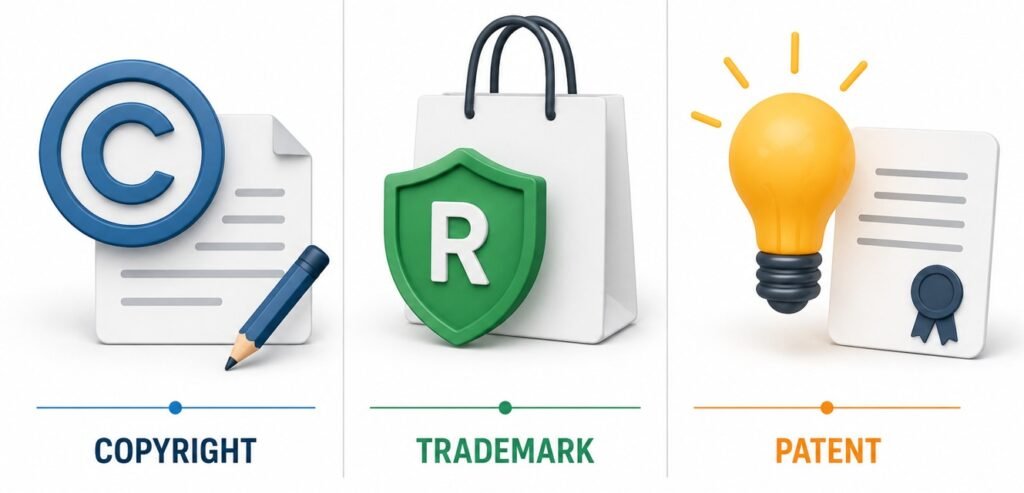
Many people have heard the words patent, trademark, and copyright, but they are often confused about what each one protects.
Some business owners try to trademark their inventions. Some inventors ask for copyright protection for their products. Others think a patent can protect their business name.
The truth is that these three types of intellectual property protection are very different.
Choosing the wrong type of protection can leave your valuable work unprotected.
In this article, we will explain the difference between copyright, trademark, and patent in very simple language so that anyone can understand.
What Is Intellectual Property?
Intellectual Property (IP) refers to creations of the human mind.
These creations can include:
- Inventions
- Brand names
- Logos
- Books
- Software
- Music
- Artwork
- Designs
Different types of intellectual property are protected in different ways.
This is where patents, trademarks, and copyrights come into the picture.
What Is a Patent?
A patent protects a new invention.
If you invent a new product, machine, device, process, or technology, you may be able to obtain a patent.
A patent gives the owner the exclusive right to prevent others from making, using, selling, or importing the invention without permission.
Examples of Things That Can Be Patented
- A new water purification system
- A medical device
- A new manufacturing process
- An innovative machine
- A new chemical composition
- A unique technology solution
Example
Suppose you invent a smart helmet that automatically sends an emergency alert after an accident.
The technology behind the helmet may be protected through a patent.
What Does a Patent Protect?
A patent protects the functional and technical aspects of an invention.
It protects how something works.
Patent Duration in India
A patent is generally valid for 20 years from the filing date, subject to payment of renewal fees.
What Is a Trademark?
A trademark protects your brand identity.
It helps customers identify your business, products, or services.
A trademark can be:
- Business name
- Brand name
- Logo
- Slogan
- Tagline
- Symbol
Examples of Trademarks
- Company names
- Product names
- Business logos
- Brand slogans
Example
Your business name IPHelm can be protected through trademark registration.
The trademark does not protect your services themselves.
Instead, it protects the name under which you provide those services.
What Does a Trademark Protect?
A trademark protects the identity of your brand.
It helps prevent others from using a similar name or logo that may confuse customers.
Trademark Duration in India
A trademark is registered for 10 years at a time and can be renewed indefinitely.
As long as renewals are filed on time, trademark protection can continue forever.
What Is Copyright?
Copyright protects original creative works.
It automatically arises when an original work is created.
Copyright generally protects the expression of an idea, not the idea itself.
Examples of Copyrighted Works
- Books
- Articles
- Blog posts
- Photographs
- Paintings
- Music
- Videos
- Software code
- Website content
Example
Suppose you write a book about startup funding.
The content of the book can be protected by copyright.
Someone cannot legally copy and publish your work as their own.
What Does Copyright Protect?
Copyright protects creative expression.
It protects how ideas are written, drawn, recorded, or presented.
Copyright Duration in India
For most literary, artistic, dramatic, and musical works, copyright generally lasts for the author’s lifetime plus 60 years after death.
The Easiest Way to Understand the Difference
Imagine you create a new product and start a business around it.
The Product
You invent a smart water bottle that reminds people to drink water.
The technology inside the bottle may be protected by a patent.
The Brand Name
You sell the bottle under the name HydroSmart.
The brand name can be protected by a trademark.
The User Manual
You create a detailed instruction guide and promotional content.
The written content can be protected by copyright.
In this single example:
- Patent protects the invention.
- Trademark protects the brand.
- Copyright protects the content.
Quick Comparison
Patent
Protects:
- Inventions
- Products
- Processes
- Technology
Purpose:
- Protects how something works
Duration:
- 20 years
Trademark
Protects:
- Brand names
- Logos
- Slogans
Purpose:
- Protects business identity
Duration:
- 10 years and renewable forever
Copyright
Protects:
- Books
- Articles
- Music
- Software
- Artwork
- Website content
Purpose:
- Protects creative expression
Duration:
- Generally lifetime of author plus 60 years
Can One Business Need All Three?
Yes.
Many businesses use all three forms of protection.
For example, a technology startup may have:
- A patented invention
- A registered trademark for its brand
- Copyright protection for its website, software, and marketing materials
Each type of protection serves a different purpose.
Using the right combination can provide stronger protection for the business.
Common Mistakes People Make
Mistake 1: Thinking a Trademark Protects an Invention
A trademark protects a brand name.
It does not protect the technology behind a product.
Mistake 2: Thinking Copyright Protects an Idea
Copyright protects the expression of an idea.
It does not protect a mere idea.
Mistake 3: Thinking a Patent Protects a Business Name
Patents protect inventions.
Business names are generally protected through trademarks.
Mistake 4: Not Protecting Intellectual Property Early
Many businesses wait too long before protecting their intellectual property.
By then, competitors may already be using similar names, content, or technology.
Which Protection Do You Need?
The answer depends on what you want to protect.
You Need a Patent If:
- You have created a new invention.
- You have developed a new product.
- You have a unique technical solution.
- You have invented a new process.
You Need a Trademark If:
- You want to protect your brand name.
- You want to protect your logo.
- You want customers to recognize your business.
You Need Copyright If:
- You have written original content.
- You have created software code.
- You have designed artwork.
- You have produced videos, photographs, or music.
Can Startups Benefit From Intellectual Property Protection?
Absolutely.
Many startups build their value around intellectual property.
Strong intellectual property protection can:
- Increase business value
- Attract investors
- Build customer trust
- Prevent copying
- Create competitive advantages
For this reason, intellectual property should be considered from the early stages of business development.
Final Thoughts
Patent, trademark, and copyright protection serve different purposes.
A patent protects inventions and technology.
A trademark protects brand names, logos, and business identity.
A copyright protects original creative works such as articles, books, software, and artwork.
Understanding the difference is important because choosing the correct type of protection can help secure your ideas, brand, and creative work.
At IPHelm, we help startups, businesses, creators, researchers, and inventors protect their intellectual property through patent, trademark, copyright, and design registration services.
Not sure which protection is right for you? Contact IPHelm today and our team will help you identify the best way to protect your intellectual property.