
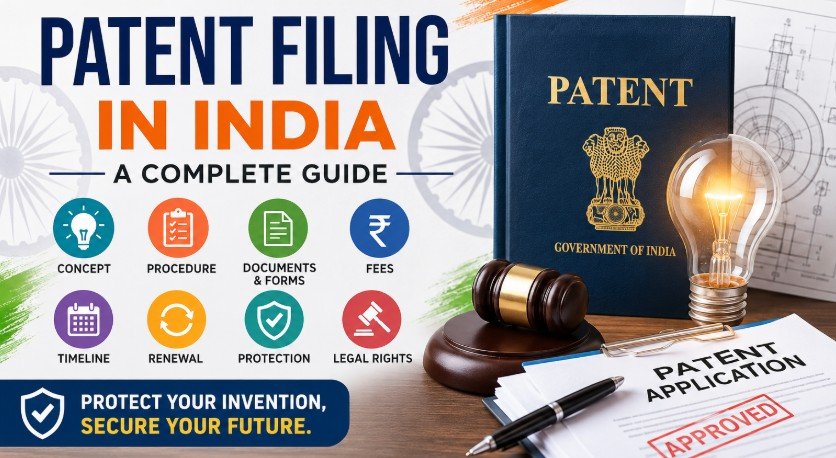
A patent is a legal right granted to an inventor for a new invention. It provides the patent owner with exclusive rights to prevent others from making, using, selling, or importing the invention without permission. In India, patents are governed by the Patents Act, 1970 and the Patents Rules, 2003. This article explains the concept of patents, the patent filing procedure, required documents and forms, government fees, timeline for grant, and the process of patent renewal.
The Patents Act, 1970
The Patents Act, 1970 is the primary law governing patents in India. It defines inventions, lays down the procedure for obtaining patents, and grants exclusive rights to inventors for a period of 20 years from the filing date.
Introduction
Innovation drives technological and economic growth. A patent encourages innovation by granting inventors exclusive rights over their inventions for a limited period. In return, the inventor publicly discloses the invention, allowing society to benefit from technological advancements after the patent expires.
What is a Patent?
A patent is an exclusive legal right granted by the Government of India to an inventor for a new product or process. Once granted, the patent holder can stop others from making, using, selling, offering for sale, or importing the patented invention without authorization.
Essential Requirements for a Patent
Novelty
The invention must be new and should not have been publicly disclosed anywhere in the world before the filing date.
Inventive Step
The invention must involve a technical advancement and should not be obvious to a person skilled in the relevant field.
Industrial Applicability
The invention must be capable of being manufactured or used in an industry.
What Cannot Be Patented?
The following are generally not patentable in India:
- Scientific discoveries and natural substances.
- Mathematical methods and business methods.
- Computer programs per se.
- Methods of medical treatment.
- Traditional knowledge.
- Inventions contrary to public order or morality.
Why Protect an Invention?
A patent provides several benefits, including:
- Exclusive commercial rights.
- Protection against copying.
- Licensing and royalty opportunities.
- Increased business value.
- Legal remedies against infringement.
Patent Filing Process in India
Step 1: Patentability Search
Conduct a patent search to determine whether the invention is new and patentable.
Step 2: Draft the Patent Specification
Prepare either a Provisional Specification or a Complete Specification describing the invention in detail.
Step 3: File the Patent Application
Submit the patent application online with the required forms and supporting documents.
Step 4: Publication
The application is ordinarily published after 18 months. Early publication can be requested by filing Form 9.
Step 5: Request for Examination
File Form 18 (or Form 18A for eligible applicants) to request examination of the patent application.
Step 6: Examination
The Patent Office examines the application and issues a First Examination Report (FER), if necessary. The applicant must respond to the objections within the prescribed time.
Step 7: Grant of Patent
If all objections are resolved and the application complies with the law, the Controller grants the patent.
Documents and Forms Required
Form 1 – Application for Grant of Patent
Contains details of the applicant, inventor, and invention.
Form 2 – Provisional or Complete Specification
Provides a detailed description of the invention.
Form 3 – Statement and Undertaking
Discloses details of corresponding foreign patent applications.
Form 5 – Declaration of Inventorship
Declares the true and first inventor(s) of the invention.
Other Documents
- Power of Attorney (Form 26), where applicable.
- Priority documents, if claiming priority.
- Drawings, abstract, and sequence listing, if required.
Patent Filing Fees in India
Government fees vary depending on the applicant category, such as an individual, startup, small entity, or large entity. Professional fees charged by patent agents or attorneys are separate from the official government fees.
Patent Filing Timeline
The overall timeline depends on the examination process. With regular examination, a patent is generally granted within 2–5 years, while expedited examination may significantly reduce the timeline for eligible applicants.
Patent Renewal Process
A patent remains valid for 20 years from the filing date, provided the annual renewal fees are paid from the third year onwards. Failure to pay the renewal fee may result in the patent lapsing, although restoration may be available in certain cases.
Conclusion
A patent is an important intellectual property right that protects innovative products and processes. Proper patent drafting, timely filing, and compliance with the Patents Act, 1970 are essential for obtaining and maintaining patent protection in India. Filing a patent not only safeguards an invention but also enhances its commercial value and provides a competitive advantage in the marketplace.