
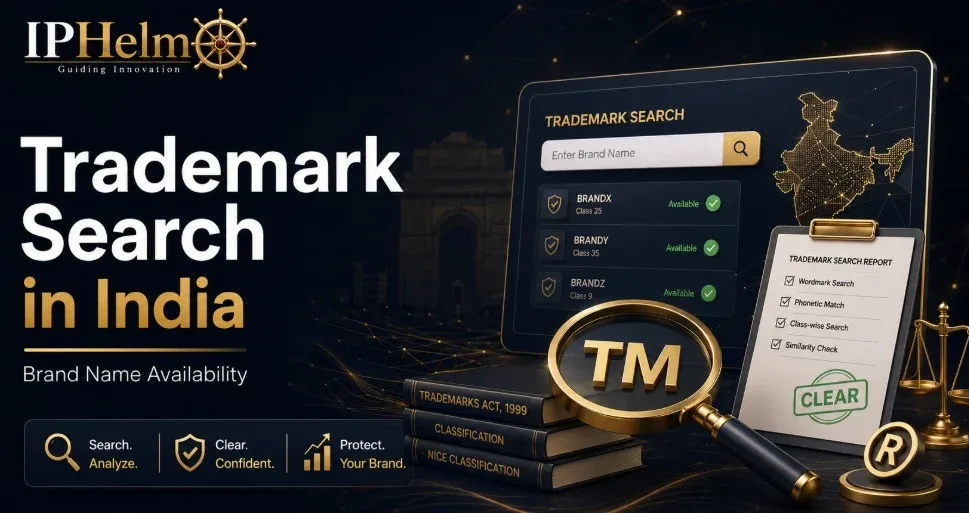
Choosing a brand name is an important step when starting a business. However, before printing packaging, creating a website or investing in advertising, you should check whether the proposed name is legally available.
A trademark search in India helps identify earlier trademark applications and registrations that may conflict with your proposed brand name, logo or tagline. A proper search can reduce the risk of objections, opposition proceedings, rebranding expenses and legal disputes.
The Indian Trade Marks Registry provides an official trademark public search facility through which users can search existing and pending marks. However, simply entering the exact brand name once is not enough. A reliable trademark availability search should cover spelling variations, similar-sounding marks, related classes and visual elements.
What Is a Trademark Search?
A trademark search is the process of checking whether an identical or similar trademark has already been applied for, registered or used by another person.
The search is generally conducted before filing a trademark application. It helps determine whether the proposed mark is:
- Unique and distinctive
- Similar to an earlier trademark
- Descriptive of the relevant goods or services
- Likely to confuse customers
- Suitable for filing in the selected trademark class
Under the Trade Marks Act, a mark may be considered deceptively similar when it resembles another mark so closely that it is likely to deceive people or cause confusion. Therefore, trademark similarity is not limited to exact spelling.
Why Is a Trademark Search Important Before Filing?
The Trade Marks Registry itself identifies checking trademark availability as the first step before selecting the class and filing Form TM-A. Applicants are expected to search existing marks, assess possible conflicts and decide whether they should apply for a word mark or logo mark.
A trademark search before filing can help you:
- Avoid selecting a brand name already owned by another business
- Identify identical and similar trademark applications
- Reduce the possibility of a Section 11 objection
- Assess whether the mark is distinctive enough under Section 9
- Avoid spending money on branding that may later need to be changed
- Select a legally stronger alternative brand name
- Reduce the risk of receiving a legal notice from an earlier user
The search does not guarantee registration. The final decision remains with the Trade Marks Registry, and third parties may also oppose an application after publication. However, a proper search allows the applicant to understand major risks before investing in the filing.
What Should Be Checked During a Trademark Search?
A complete brand name search in India should not be restricted to the exact proposed word. The following aspects should be checked.
Exact Matches
Search the exact spelling of the proposed trademark. For example, if the proposed mark is “NOVENTA,” the first search should check whether “NOVENTA” already appears in the relevant class.
Similar Spellings
Small changes in spelling do not always make a trademark legally different. The search should also cover variations such as:
- NOVENTA
- NOVENTAA
- NOVENTAAS
- NOVENTRA
- NO VENTA
Adding a letter, changing the ending or separating the words may not avoid a conflict where the overall impression remains similar.
Phonetically Similar Marks
A trademark phonetic search identifies marks that may sound similar even when their spellings are different.
For example:
- Kwick and Quick
- Lite and Light
- Xpert and Expert
- Kool and Cool
Consumers often remember trademarks by sound. Therefore, phonetic similarity can create confusion even where the written appearance differs.
Similar Meaning or Concept
Marks may also require assessment for similarity in meaning or idea. Translating a known mark into another language or replacing a word with a close synonym may not always create a safe trademark.
Logo and Device Elements
Where the proposed trademark contains a logo, symbol, device, animal, object or geometric design, a separate device-mark search should be conducted through the Vienna Classification.
A wordmark search alone will not properly identify visually similar logos.
Select the Correct Trademark Class
Trademark rights are connected to the goods or services for which registration is sought. The Nice Classification divides trademarks into 45 classes:
- Classes 1 to 34 cover goods
- Classes 35 to 45 cover services
Selecting the correct class and clearly describing the goods or services is necessary for meaningful protection.
The 13th edition of the Nice Classification came into effect on 1 January 2026. Applicants should therefore use the latest classification while preparing new applications.
Some common examples include: - Class 3: Cosmetics and cleaning preparations
- Class 9: Software, electronic devices and scientific instruments
- Class 25: Clothing, footwear and headgear
- Class 30: Coffee, tea, bakery products and certain food products
- Class 35: Advertising, business management and retail services
- Class 41: Education, training and entertainment services
- Class 42: Software development, scientific and technological services
A business may require protection in more than one class. For example, a clothing brand selling products through its own retail store may need to examine both Class 25 and Class 35.
The search should cover the main class as well as any related classes where similar businesses may have filed their marks.
How to Conduct a Trademark Search on the IP India Portal
Step 1: Open the Official Trademark Public Search
Use the official IP India trademark public search facility. The portal provides access to pending and registered trademarks and presently allows login through an email address or mobile number with OTP verification.
The official search interface is available to the public without a professional search fee.
Step 2: Select the Search Category
The trademark public search provides three principal categories:
- Wordmark
- Vienna Code
- Phonetic
The Wordmark option permits searching by the word, class and goods or services information. Vienna Code search is used for device or logo elements, while Phonetic search produces marks that sound similar to the entered word.
Step 3: Conduct a Wordmark Search
Enter the proposed brand name and select the relevant trademark class.
Do not rely on only one search. Search:
- The complete proposed mark
- Its important individual words
- The first and dominant part of the mark
- Alternative spellings
- Singular and plural forms
- Marks with added prefixes or suffixes
For example, when searching “GREENBASKET,” the search should also examine “GREEN BASKET,” “GREEN,” “BASKET,” “GRENBASKET” and other close variants.
Step 4: Conduct a Phonetic Search
Use the Phonetic option with the proposed word and relevant class. This is particularly important where the mark contains:
- Invented spellings
- Replaced letters
- Numbers used as words
- Silent letters
- Regional-language pronunciations
A brand may appear visually different but still create a conflict because it sounds like an earlier trademark.
Step 5: Conduct a Vienna Code Search for Logos
The Vienna Classification groups visual elements into categories and codes. For example, logos may contain:
- Stars
- Birds or animals
- Human figures
- Crowns
- Leaves or trees
- Circles, triangles or other geometric shapes
Identify the appropriate Vienna Code and search it with the relevant class. Complex logos may contain several visual elements and may require searches under more than one code.
Step 6: Review the Search Results Carefully
Finding a similar mark does not automatically mean that your trademark cannot be filed. Each result should be examined for:
- Trademark name and representation
- Application number
- Proprietor’s name
- Application status
- Relevant class
- Description of goods or services
- Date of application
- Claimed date of use
- Whether the mark is registered, objected, opposed, abandoned or removed
An abandoned application may carry less risk than a valid registration, but it should not be ignored. The proprietor may still be using the mark and may have rights based on earlier commercial use.
How to Analyse Similar Trademarks
Trademark similarity must be assessed as a whole. Important factors include:
- Visual similarity
- Phonetic similarity
- Structural similarity
- Meaning or concept
- Dominant part of the mark
- Nature of the goods or services
- Target customers
- Method of purchase
- Trade channels
Section 11 of the Trade Marks Act prevents registration where an identical or similar mark, combined with identical or similar goods or services, creates a likelihood of confusion or association with an earlier trademark. Well-known marks may also receive protection in relation to dissimilar goods or services in certain circumstances.
For example, two similar marks used for medicines may create a higher risk of confusion than similar marks operating in completely unrelated commercial fields. The overall legal assessment should therefore consider both the marks and the market in which they are used.
Difference Between Section 9 and Section 11
A trademark search should examine both the inherent strength of the mark and conflicts with earlier rights.
Section 9: Absolute Grounds for Refusal
Section 9 concerns the nature of the proposed trademark itself. Registration may be refused where a mark:
- Lacks distinctive character
- Directly describes the goods or services
- Has become customary in the trade
- Is deceptive or likely to cause confusion
- Contains prohibited, scandalous or offensive matter
For example, “SWEET” for chocolates or “FAST DELIVERY” for courier services may face objections because they directly describe characteristics of the goods or services.
Section 11: Relative Grounds for Refusal
Section 11 concerns conflicts with earlier trademarks or rights. An objection may arise where the proposed mark is identical or similar to an earlier trademark covering identical or similar goods or services, resulting in a likelihood of confusion.
A mark may therefore be distinctive under Section 9 but still face refusal under Section 11 because another person filed or registered a similar mark earlier.
Does an Available Company Name Mean the Trademark Is Available?
No. Approval of a company, LLP or business name does not automatically provide trademark protection.
A company-name search and a trademark search serve different purposes. Similarly, the availability of a website domain or social-media username does not confirm that the brand is legally available as a trademark.
Before using a business name commercially, the applicant should separately check:
- Trade Marks Registry records
- Existing business use
- Company and LLP names
- Domain names
- Online marketplaces
- Search engines and social-media platforms
This wider search is important because unregistered users may also possess enforceable rights. Section 11 recognises passing-off rights, while Section 34 protects certain earlier continuous users against later registered proprietors.
What Should You Do If a Similar Trademark Exists?
The correct response depends on the degree of similarity and the relevant goods or services.
Possible options include:
- Choosing a completely new brand name
- Modifying the mark before commercial launch
- Removing a conflicting or descriptive element
- Filing in a different class where genuinely appropriate
- Limiting the goods or services specification
- Obtaining consent from the earlier proprietor in suitable cases
- Proceeding with legal arguments where the marks and businesses are distinguishable
Adding a generic word such as “India,” “Enterprise,” “Solutions,” “Global” or “Official” may not sufficiently distinguish the mark. The distinctive and memorable part of the brand must be considered.
Common Trademark Search Mistakes
Applicants frequently make the following mistakes:
- Searching only the exact spelling
- Ignoring phonetic similarity
- Searching in the wrong class
- Checking only one class
- Ignoring pending applications
- Looking only at registered marks
- Failing to search the logo through Vienna Codes
- Assuming an available domain name means the trademark is available
- Ignoring unregistered market users
- Treating an abandoned trademark as automatically risk-free
- Filing a descriptive or generic mark without assessing Section 9
Another common mistake is checking whether a mark appears in the search results but failing to review the actual goods and services. Two marks in the same class may still cover different products, while marks in different classes may sometimes operate in closely related markets.
Is a Professional Trademark Search Necessary?
Anyone may use the IP India trademark search facility. However, finding search results is only the first part of the process. The difficult task is analysing whether the marks are legally similar and whether their goods, customers and commercial channels overlap.
A professional trademark search can include:
- Exact and variant searches
- Phonetic searches
- Vienna Code searches
- Related-class searches
- Review of application status
- Assessment under Sections 9 and 11
- A risk opinion before filing
This is particularly useful where a business plans to invest heavily in packaging, advertising, franchise expansion or online sales.
Conclusion
A trademark search in India should be completed before filing an application or making a major investment in a new brand. A basic exact-name search is not sufficient. Applicants should examine spelling variations, phonetic similarities, relevant trademark classes, visual elements and existing market use.
The search results must then be analysed under Sections 9 and 11 of the Trade Marks Act, 1999. Even where no identical trademark appears, a similar-sounding or conceptually similar mark may still create legal risk.
Need help checking trademark availability in India? IPHelm provides professional trademark searches, legal risk assessments and end-to-end trademark filing support. Contact us before launching your brand to identify possible conflicts and select a stronger trademark.