
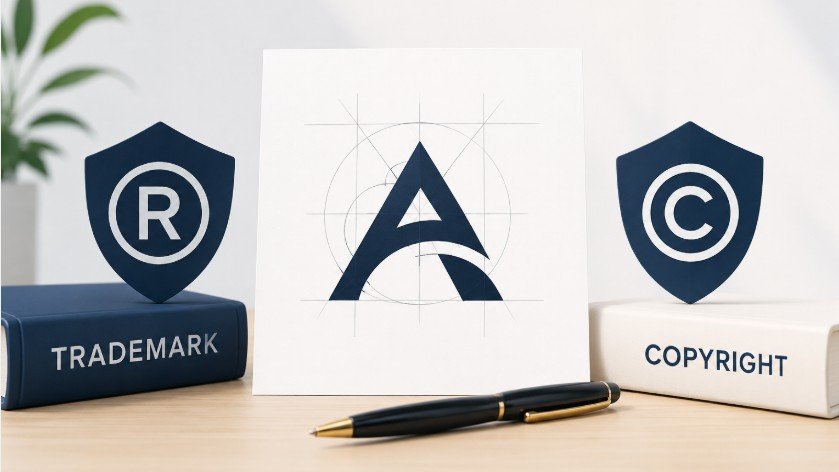
A logo is one of the most important parts of a business identity. It helps customers recognise a business, remember its products and separate it from competitors.
After creating a logo, many business owners ask the same question:
Should I register my logo as a trademark or copyright?
The correct answer is that a logo may be protected under both trademark law and copyright law. However, these two protections are not the same. They protect different aspects of the logo and provide different legal rights.
This article explains the difference between trademark and copyright protection for a logo and helps you decide which registration is more suitable for your business.
What Does Logo Registration Mean in India?
There is no separate law called “logo registration law” in India. A logo is generally protected through:
- Trademark registration under the Trade Marks Act, 1999
- Copyright protection under the Copyright Act, 1957
A logo used to identify a business, product or service can be registered as a trademark. At the same time, an original logo design may also qualify as an artistic work under copyright law.
Therefore, the same logo may receive protection under both laws.
Can a Logo Be Registered as a Trademark?
Yes. A logo can be registered as a trademark in India.
The Indian Trade Marks Office recognises logos, symbols and devices as forms of trademarks. A trademark helps customers identify that particular goods or services come from a specific business.
For example, when customers see a particular symbol on shoes, mobile phones or food products, they may immediately connect it with a particular company. This ability to identify the source of products or services is the main purpose of a trademark.
What Does Trademark Protection Cover?
Trademark registration protects the logo in relation to the goods or services mentioned in the trademark application.
It can help the owner stop another person from using:
- The same logo
- A deceptively similar logo
- A confusingly similar symbol
- A similar logo for related goods or services
Trademark protection is not automatically unlimited. Its scope normally depends on the registered mark, the goods or services covered and the possibility of confusion among customers.
A trademark may be refused when it is not distinctive or when it conflicts with an earlier trademark. Sections 9 and 11 of the Trade Marks Act deal with these important grounds for refusal.
How Long Does Trademark Protection Last?
A registered trademark is valid for ten years. It can be renewed repeatedly for further periods of ten years.
This means that trademark protection can continue indefinitely as long as the owner renews the registration and follows the legal requirements.
Logo Mark and Word Mark: What Is the Difference?
A business may apply for its brand name, logo or both.
Word Mark
A word mark protects the name or word used by the business.
For example, when a business registers its brand name as a word mark, the protection is mainly connected with that name, regardless of ordinary changes in font or presentation.
Logo or Device Mark
A logo mark, also called a device mark, protects the visual representation filed in the application.
It may include:
- A symbol
- A picture
- A particular font
- A specific arrangement of words
- A combination of words and graphics
When a trademark contains several elements, registration generally protects the mark as a whole.
For better brand protection, a business may consider filing separate trademark applications for its brand name and logo. This can be useful when the company changes the design of its logo but continues using the same brand name.
Can a Logo Be Protected by Copyright?
Yes. An original logo design may be protected under copyright law as an artistic work.
Copyright protects original creative expressions, including certain drawings, graphics, illustrations and artistic designs. The Copyright Act provides protection to original artistic works.
However, every logo does not automatically qualify for strong copyright protection.
A very simple design containing only common shapes, ordinary letters or familiar symbols may not have enough originality. Copyright protects original creative expression, not a general idea, business name or common symbol.
Is Copyright Registration Compulsory?
No. Copyright protection generally begins automatically when an original work is created.
Registration is not compulsory for acquiring copyright. However, a copyright registration certificate and the entries in the Copyright Register can serve as prima facie evidence in a legal dispute relating to ownership.
Therefore, registration can make it easier to establish:
- Who owns the logo
- Who created it
- When it was created
- Whether the owner has legal rights over it
What Does Copyright Protect in a Logo?
Copyright protects the original artistic expression of the logo.
It may help the owner take action when someone:
- Directly copies the logo artwork
- Reproduces the design
- Makes an unauthorised adaptation
- Uses the artwork without permission
Copyright does not mainly focus on customer confusion or the category of goods and services. Those issues are more closely connected with trademark law.
How Long Does Copyright Protection Last?
For an artistic work published during the author’s lifetime, copyright generally lasts for the lifetime of the author plus sixty years, calculated according to the Copyright Act.
The exact term may differ in special cases, such as anonymous works, government works or works with other ownership arrangements.
Trademark vs Copyright for a Logo
The following comparison explains the main difference:
| Point | Trademark | Copyright |
|---|---|---|
| Main purpose | Protects the logo as a business or brand identity | Protects the original artwork |
| Relevant law | Trade Marks Act, 1999 | Copyright Act, 1957 |
| Registration | Required for statutory trademark registration | Protection is generally automatic, but registration is useful |
| Scope | Connected with registered goods or services | Connected with copying or reproduction of the artwork |
| Validity | Ten years and renewable repeatedly | Generally the author’s lifetime plus sixty years |
| Main concern | Customer confusion and brand misuse | Unauthorised copying of creative work |
| Government office | Trade Marks Registry | Copyright Office |
| Classification | Filed according to relevant trademark classes | Registered as an artistic work |
Which Is Better for a Logo: Trademark or Copyright?
For most businesses, trademark registration is more important because a logo is mainly used as a brand identifier.
Trademark protection can help prevent competitors from using an identical or confusingly similar logo in the market. It directly protects the connection between the logo and the business’s goods or services.
Copyright is also valuable, especially when the logo contains original artwork. It protects the creative design against unauthorised copying.
Therefore, trademark and copyright should not always be treated as alternatives. In suitable cases, they can work together.
Should You Register Your Logo Under Both Laws?
For an important business logo, obtaining both trademark and copyright protection may provide stronger legal coverage.
Trademark registration can protect the logo as a brand in the marketplace. Copyright can protect the artwork used in that logo.
For example, suppose another business uses a very similar logo for related services. Trademark law may help when the use creates confusion among customers.
Now suppose someone directly copies the artwork and places it on a website, poster or product. Copyright law may provide additional protection against reproduction of the artistic work.
Registering under both laws may therefore help protect both:
- The commercial identity of the logo
- The artistic design of the logo
However, the correct filing strategy depends on the nature of the logo, its originality, its commercial use and the business activities connected with it.
Important Issue: Who Owns the Logo?
Ownership is one of the most important issues in logo protection.
Many businesses hire:
- Freelance graphic designers
- Design agencies
- Employees
- Marketing companies
- Online logo designers
Paying a designer does not always mean that all copyright rights have automatically transferred to the business.
Under copyright law, the author is generally treated as the first owner, subject to certain legal exceptions. A copyright assignment must be made in writing and signed by the person assigning the rights.
Therefore, when a freelancer or outside agency creates the logo, the business should obtain a proper written agreement or copyright assignment.
The agreement should clearly state that: - The logo was created for the business
- The business has the right to use the logo
- Copyright is assigned to the business
- The designer will not claim ownership later
- The design does not knowingly copy another person’s work
Without proper ownership documents, problems may arise during trademark registration, copyright registration, investment, franchising, licensing or enforcement.
How to Register a Logo as a Trademark in India
The general trademark registration process includes the following steps.
Step 1: Conduct a Trademark Search
Before filing, a trademark search should be conducted to check whether an identical or similar logo is already registered or pending.
For logos, the search may involve the visual elements of the mark and the relevant Vienna Classification codes.
A proper search can reduce the risk of objections and opposition, although it cannot guarantee registration.
Step 2: Select the Correct Trademark Class
Trademark applications are filed according to the goods or services offered by the business.
There are 45 trademark classes. Classes 1 to 34 generally cover goods, while Classes 35 to 45 generally cover services.
A business operating in more than one area may require applications in more than one class.
Step 3: Identify the Correct Applicant
The application should be filed in the name of the actual owner of the logo.
The applicant may be:
- An individual
- A sole proprietorship
- A partnership firm
- An LLP
- A private limited company
- A startup
- Another legal organisation
Incorrect ownership details can create serious problems later.
Step 4: File Form TM-A
A new trademark application is generally filed through Form TM-A.
The application contains details such as:
- Applicant information
- Representation of the logo
- Description of goods or services
- Trademark class
- Date of use, where applicable
- User affidavit, where required
- Power of Attorney, where applicable
The official filing process confirms that applications may be filed as single-class or multi-class applications through Form TM-A.
Step 5: Examination by the Trade Marks Office
The application is examined to check whether it meets legal requirements.
An examination report may be issued if the Registrar finds objections. The applicant must respond within the applicable period and may also be required to attend a hearing.
Step 6: Publication in the Trade Marks Journal
When the application is accepted, it is published in the Trade Marks Journal.
Third parties receive an opportunity to oppose the application when they believe that registration may affect their earlier rights.
Step 7: Registration
When no opposition is filed, or when opposition proceedings are decided in favour of the applicant, the trademark may proceed to registration.
After registration, the owner can lawfully use the ® symbol with the registered logo. The Trade Marks Act penalises false representation of an unregistered mark as registered.
How to Register Copyright for a Logo in India
A logo is normally filed as an artistic work for copyright registration.
The general process includes:
- Confirming the author and copyright owner
- Obtaining an assignment or No Objection Certificate where required
- Preparing a clear copy of the artistic work
- Filing the copyright application
- Submitting the Statement of Particulars and other documents
- Responding to discrepancies or objections, where raised
- Completing examination and registration
Where an artistic work is used or capable of being used in relation to goods or services, a search certificate from the Registrar of Trade Marks is required under the proviso to Section 45 of the Copyright Act. The request for the certificate is made through Form TM-C.
This requirement is especially relevant for brand logos, product labels and packaging designs.
Common Mistakes in Logo Registration
Registering Only the Company Name
Registering a company, LLP, domain name or GST name does not automatically provide trademark registration.
Business registration and trademark registration are separate legal processes.
Filing in the Wrong Trademark Class
A trademark filed in an incorrect class may not provide useful protection for the actual business activities.
Using a Copied Logo
A logo downloaded from the internet or copied from another business may result in objections, opposition, copyright claims or infringement proceedings.
Not Obtaining Rights from the Designer
A business should not assume that paying the designer automatically resolves every copyright ownership issue. A written assignment or suitable agreement should be obtained.
Registering Only the Logo and Ignoring the Brand Name
A logo design may change over time. Registering the brand name separately as a word mark can provide more flexible protection.
Using the ® Symbol Before Registration
The ® symbol should be used only after the trademark has been registered. During the application stage, businesses commonly use the TM symbol instead.
Can Someone Register Your Logo Before You?
Another person may attempt to file an application for the same or a similar logo.
Whether that person can successfully obtain registration depends on several factors, including:
- Who created the logo
- Who used it first
- Whether the mark is distinctive
- Whether the other application was filed honestly
- Whether there are earlier trademark or copyright rights
- Whether the use is likely to confuse customers
This is why businesses should not delay protecting an important logo.
Maintaining invoices, design files, emails, agreements, first-use documents and advertising records can also help establish ownership and earlier use.
Final Answer: Trademark or Copyright?
A logo may be protected under both trademark and copyright law in India.
Trademark registration is usually the main protection for a business logo because it protects the logo as a brand identifier in relation to particular goods or services.
Copyright protection protects the original artistic design and helps prevent unauthorised copying or reproduction.
For a valuable and original business logo, the strongest practical approach may be to:
- Register the brand name as a word mark
- Register the logo as a device mark
- Secure copyright ownership from the designer
- Consider copyright registration for the artistic work
The correct approach should be selected after checking the logo, the business activities, the relevant trademark classes and the ownership documents.
Need Help with Logo Registration in India?
IPHelm assists individuals, startups and businesses with trademark searches, logo trademark applications, copyright registration and intellectual property protection.
A proper search and filing strategy can help avoid unnecessary objections and protect your brand from misuse.
Contact IPHelm for professional assistance with trademark and copyright registration for your logo in India.