
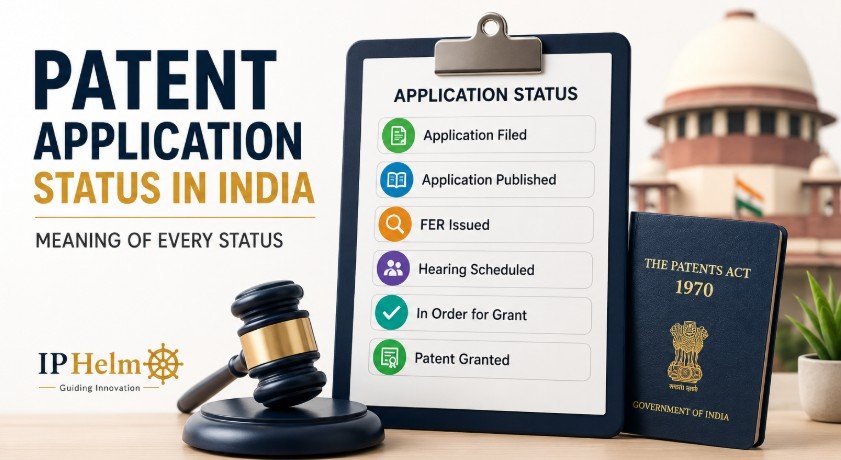
After filing a patent application, applicants often check the IP India portal and find short status messages such as “Application Published,” “FER Issued,” “Hearing Scheduled” or “In Order for Grant.”
These words may look simple, but each status shows a different stage of the patent process. Some statuses only give an update, while others may require immediate action from the applicant.
Understanding the patent application status in India can help you track progress, identify pending work and avoid missing an important deadline.
This article explains the common patent statuses in simple English and tells you what should be done at each stage.
The exact wording shown on the online portal may differ slightly from one application to another. The latest Patent Office communication, order or filed document should always be checked along with the status shown online. The Patent Office provides public access to published applications, their status, examination reports, amendments, grant details and Controller decisions through its online systems.
Table of Contents
ToggleHow to Check Patent Application Status in India
You can check the application through the official IP India patent-status facility.
Normally, you will need the complete patent application number. After entering the application number and the required security code, the portal may display:
- Applicant and inventor details
- Filing date
- Publication date
- Request for Examination details
- First Examination Report
- FER response
- Hearing notice
- Controller’s order
- Grant or refusal details
The official IP India website provides a “Track Status” service for patent applications and separate public utilities for FERs, Controller decisions and granted-patent records.
1. Application Filed
This means that the Patent Office has received the patent application and issued an application number.
At this stage, the applicant should check whether all important documents were filed correctly, such as:
- Form 1
- Provisional or complete specification in Form 2
- Drawings, where required
- Form 3
- Form 5
- Proof of right
- Power of Attorney
- Entity-status documents
The filing acknowledgement confirms filing, but it does not mean that the invention has been examined or granted.
Where a provisional specification was filed, the complete specification must be filed within 12 months. No further extension is available for filing the complete specification after this period.
2. Provisional Specification Filed
This status means that the application was filed with a provisional specification.
A provisional filing helps secure an early filing date while the invention is still being developed. However, it does not itself contain the final claim set.
The applicant must file the complete specification within 12 months from the provisional filing date. If this is not done, the application will not continue.
3. Complete Specification Filed
This means that the final technical specification has been submitted.
The complete specification normally contains:
- Full description of the invention
- Best method of performing the invention
- Claims
- Abstract
- Drawings, where required
After this stage, the applicant should ensure that publication and examination requirements are completed within the applicable deadlines.
4. Awaiting Publication
This status generally means that the application has been filed but has not yet been published.
A patent application is ordinarily published after 18 months from the filing date or priority date, whichever is earlier. An applicant may request early publication by filing Form 9.
Before publication, most application details are not open for public inspection. After publication, the specification becomes publicly available, subject to limited legal exceptions.
5. Application Published
This means that the patent application has been published in the Patent Office Journal.
Publication does not mean that the patent has been granted. It only means that the application and specification are now available to the public.
After publication:
- The application can be searched publicly.
- A pre-grant opposition may be filed before grant.
- Examination can proceed if a valid Request for Examination has been filed.
The Patent Office does not examine an application automatically. A separate examination request is required.
6. Request for Examination Not Filed
This means that Form 18 or Form 18A has not yet been filed.
A patent application cannot be examined unless a valid Request for Examination is submitted. For applications filed on or after 15 March 2024, the normal period is 31 months from the filing date or priority date, whichever is earlier. Applications filed before the 2024 amendment continue under the earlier applicable period.
If the examination request is not filed within the applicable period, the application is treated as withdrawn.
This is a deadline-sensitive status and should not be ignored.
7. Request for Examination Filed
This means that Form 18 for normal examination or Form 18A for expedited examination has been filed.
The application will enter the examination process after it has been published.
Filing the examination request does not mean that examination will begin immediately. The application may remain in the examination queue until it is referred to an Examiner.
8. Application Awaiting Examination
This status generally means that:
- The application has been published;
- The Request for Examination has been filed; and
- The application is waiting to be taken up by the Patent Office.
No FER has been issued yet.
The applicant should continue monitoring the portal and email records because the FER may contain technical, legal and procedural objections.
9. Under Examination
This means that the application has been referred to a Patent Examiner.
The Examiner may review:
- Novelty
- Inventive step
- Industrial applicability
- Patentability under Sections 3 and 4
- Clarity of claims
- Sufficiency of disclosure
- Unity of invention
- Formal documents
An Indian patent can be granted only where the invention meets the legal requirements, including novelty, inventive step and industrial applicability, and does not fall within excluded subject matter.
10. First Examination Report Issued
This status means that the Patent Office has issued the First Examination Report, commonly called the FER.
The FER may contain objections relating to:
- Lack of novelty
- Lack of inventive step
- Section 3 exclusions
- Unclear claims
- Insufficient disclosure
- Lack of support
- Missing documents
- Incorrect amendments
The FER is not a final refusal. It gives the applicant an opportunity to reply and bring the application into order for grant.
The normal period for putting the application in order for grant is six months from the date of the first statement of objections. The Rules also provide for extensions subject to the applicable provisions and filing requirements.
11. FER Response Filed
This means that the applicant has submitted a reply to the examination objections.
The response may include:
- Written arguments
- Comparison with prior art
- Amended claims
- Corrected specification pages
- Supporting documents
- Procedural compliance
Filing a response does not automatically remove the objections. The Controller will review whether the reply and amendments satisfy the Patents Act and Rules.
12. FER Response Under Consideration
This usually means that the Patent Office is reviewing the response filed by the applicant.
At this stage, the Controller may:
- Accept the response;
- Raise further concerns;
- Ask for amendments;
- Schedule a hearing; or
- Proceed towards grant.
The applicant should keep all cited prior-art documents, amended claims and technical explanations ready in case a hearing notice is issued.
13. Hearing Notice Issued
This means that the Controller is not fully satisfied with the written response and has scheduled a hearing.
A hearing notice does not mean that the application has already been refused. It gives the applicant another opportunity to answer the remaining objections.
The hearing may cover:
- Novelty
- Inventive step
- Section 3 objections
- Claim support
- Clarity
- Sufficiency of disclosure
- Formal requirements
Written submissions and supporting documents must be filed within 15 days from the hearing date.
14. Hearing Scheduled
This means that a hearing date and time have been fixed.
The applicant or patent agent should prepare:
- Objection-wise oral arguments
- Current claims
- Prior-art comparison
- Supporting paragraphs from the specification
- Proposed amendments, where required
- Relevant legal provisions
Many patent hearings are conducted through video conferencing. The applicant should also check the official cause list and hearing link.
15. Hearing Attended or Written Submissions Filed
This means that the hearing has taken place and the written arguments have been submitted.
The application is now waiting for the Controller’s consideration.
No new technical matter should be introduced at this stage. Any claim amendment must remain supported by the originally filed specification.
16. Awaiting Controller’s Decision
This status generally means that examination or hearing proceedings have been completed and the final order is pending.
The Controller may:
- Allow the application;
- Require further amendment;
- Grant the patent; or
- Refuse the application.
The applicant should check both the status page and the Controller’s decision portal because the full reasoning will be contained in the official order.
17. In Order for Grant
This is a positive status.
It generally means that the technical, legal and procedural objections have been resolved and the application has been found ready for grant.
However, the patent number or grant certificate may not yet have been issued. The application can remain at this stage while the Patent Office completes the final grant process.
Under Section 43, once an application is found to be in order and is not refused or otherwise barred, the patent must be granted as expeditiously as possible.
18. In Order for Grant—Awaiting Compliance
Sometimes the status may indicate that the application is otherwise ready for grant but a specific requirement is still pending.
Examples may include:
- Required approval
- Corrected document
- Ownership clarification
- Biological-material compliance
- Procedural formality
The exact pending requirement should be identified from the FER, hearing record or Patent Office communication.
19. Patent Granted
This means that the patent has officially been granted.
The Patent Office enters the grant date in the Register and publishes the fact of grant. The patent certificate can then be obtained from the online system.
After grant, the patentee should:
- Download the patent certificate;
- Check the granted claims;
- Pay accumulated and future renewal fees;
- Monitor possible infringement;
- Record assignments or licences where required.
A granted patent normally has a term of 20 years from the filing date, subject to payment of renewal fees.
20. Pre-Grant Opposition Filed
This means that a third party has opposed the patent application before grant.
The application may not proceed directly to grant until the opposition is dealt with.
The applicant may be required to file:
- Reply statement
- Evidence
- Amended claims
- Hearing arguments
The time taken for disposal may increase when a pre-grant opposition is pending.
21. Application Refused
This means that the Controller has passed an order refusing the patent application.
Refusal may occur because:
- Patentability objections were not overcome;
- The invention falls under excluded subject matter;
- The claims lack support or clarity;
- The applicant failed to comply with required amendments.
Section 15 allows the Controller to refuse an application or require amendment where the application does not comply with the Act.
The refusal order should be read carefully. Depending on the facts, the applicant may consider an appeal before the appropriate High Court.
22. Application Abandoned
This generally means that the application ended because the applicant did not complete a required step within the prescribed period.
Common reasons include:
- Complete specification not filed after provisional filing;
- FER requirements not completed within time;
- Required response or document not filed;
- Hearing-related compliance not completed.
Abandonment often happens automatically by operation of law. It may not always require a detailed refusal order.
23. Application Withdrawn
This means that the applicant has voluntarily requested withdrawal of the patent application.
An applicant may withdraw an application after filing and before grant by making the prescribed request.
Withdrawal may be chosen where:
- The invention is no longer commercially useful;
- Strong prior art has been found;
- The applicant does not want publication;
- The application cannot be defended;
- The business wants to stop further cost.
A withdrawn application will not proceed to grant.
24. Treated as Withdrawn or Deemed Withdrawn
This means that the application is treated as withdrawn because a legal requirement was not completed.
The most common example is failure to file the Request for Examination within the applicable period. Section 11B states that such an application is treated as withdrawn by the applicant.
This is different from a voluntary withdrawal because the status results from missing a statutory requirement.
25. Application Disposed
“Disposed” is a broad administrative term.
It usually means that the Patent Office has completed action on the application. The final result may be:
- Granted;
- Refused;
- Withdrawn; or
- Abandoned.
The detailed status or Controller’s order should be checked to understand the exact outcome. Patent Office reports commonly treat grants, refusals, withdrawals and abandoned applications as different forms of disposal.
26. Patent Ceased or Lapsed
This status applies after grant.
It generally means that the patent stopped having effect because the renewal fee was not paid within the prescribed or extended period.
The Patents Act states that a patent ceases to have effect where the renewal fee is not paid in time.
Restoration may be possible in eligible cases, but it requires a separate application and proof that the failure was unintentional.
27. Patent Expired
This means that the 20-year patent term has ended.
After expiry, the patented subject matter is no longer protected by that patent and generally enters the public domain.
For PCT national-phase applications, the 20-year term is counted from the international filing date.
What Should You Do After Checking the Status?
Do not stop after reading the one-line status.
You should also check:
- Filed documents
- Patent Office correspondence
- FER
- Hearing notice
- Written submissions
- Controller’s order
- Upcoming deadlines
A status such as “FER Issued,” “Hearing Scheduled” or “Awaiting Compliance” may require immediate action. A short delay can affect the entire application.
Common Mistakes While Tracking Patent Status
Applicants often make these mistakes:
- Checking only email and not the online portal;
- Checking only the one-line status;
- Missing the FER response deadline;
- Assuming publication means grant;
- Assuming “In Order for Grant” means the patent certificate is already issued;
- Ignoring a hearing notice;
- Failing to check renewal fees after grant;
- Using an incomplete or incorrect application number.
Conclusion
Patent application status in India shows where an application currently stands, but each status has a different meaning.
“Application Filed” only confirms filing. “Application Published” means the specification is public. “FER Issued” requires a detailed response. “Hearing Scheduled” means objections are still pending. “In Order for Grant” is a positive stage, while “Patent Granted” confirms that the legal right has been issued.
Statuses such as “Abandoned,” “Withdrawn,” “Refused” and “Treated as Withdrawn” indicate that the application is no longer proceeding through the normal grant process.
Not sure what your patent status means or what action is required? IPHelm provides professional support for patent-status review, examination requests, FER responses, hearings, grant follow-up, renewals and restoration before the Indian Patent Office.