
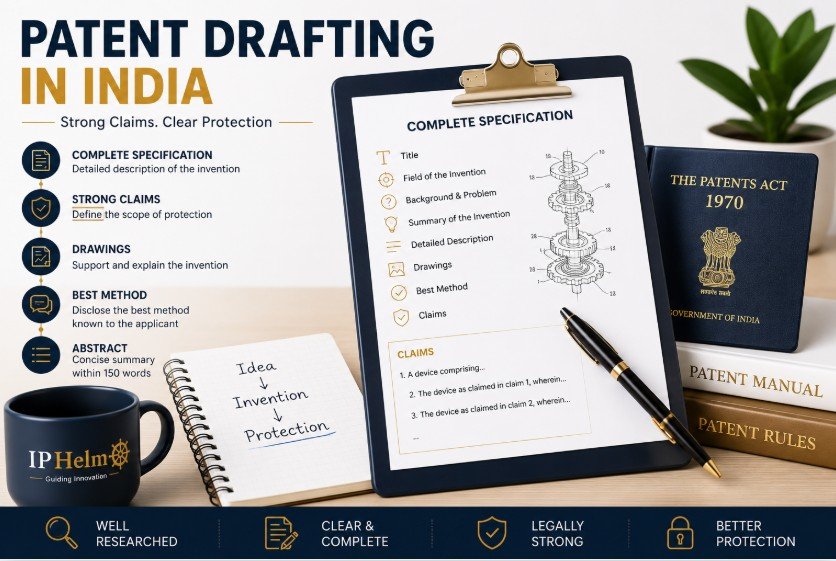
A good invention can lose valuable protection if the patent application is drafted poorly. Patent drafting is not simply writing a technical report about the invention. A patent specification must explain the invention clearly and also define the exact legal protection requested by the applicant. The description explains how the invention works. The claims define what the applicant wants to protect.
If the claims are too broad, the Patent Office may object because they cover earlier technology or more than what the inventor has actually developed. If the claims are too narrow, competitors may avoid infringement by making a small change.
This is why patent drafting in India requires a proper understanding of both technology and patent law.
What Is Patent Drafting?
Patent drafting is the process of preparing the technical and legal documents used to file a patent application.
The main document is the patent specification, which is filed in Form 2. Depending on the stage of development, the application may contain:
- A provisional specification; or
- A complete specification.
A complete specification is a techno-legal document. It must fully describe the invention and explain the best method known to the applicant for performing it. It must also end with claims defining the scope of protection requested.
Why Is Patent Drafting Important?
The Patent Office examines the invention mainly on the basis of the written specification and claims.
The Examiner does not automatically know:
- What part of the invention is new;
- How it differs from earlier technology;
- Which features are essential;
- What technical benefit it provides; or
- What exact protection the inventor wants.
These points must be explained properly in the patent application.
The claims become especially important after grant because they define the legal boundary of the patent. A feature described in the specification but not covered by the granted claims may not receive the same enforceable protection. The Patent Office Manual describes claims as the most critical part of the application because they define the legal scope of the invention.
Provisional Specification and Complete Specification
Before drafting, the applicant should decide whether to file a provisional specification or a complete specification.
Provisional Specification
A provisional specification may be filed when the invention is still under development but the applicant wants to secure an early filing date.
It normally contains:
- Title of the invention;
- Technical field;
- Background;
- Problem being addressed;
- Main features of the invention;
- Working concept;
- Available examples or results; and
- Drawings, where useful.
The Patent Office Manual advises applicants to include as much information as they have at the time of filing. Claims are generally not necessary in a provisional specification because its main purpose is to describe the invention and secure a priority date.
A weak provisional specification can create serious problems. A feature added only in the complete specification may not receive the earlier priority date unless it was properly supported by the provisional disclosure.
Complete Specification
A complete specification contains the final and detailed disclosure of the invention.
Under Section 10, it must:
- Fully and particularly describe the invention;
- Explain its operation or use;
- Explain the method by which it is performed;
- Disclose the best method known to the applicant;
- End with claims defining the requested protection; and
- Be accompanied by an abstract.
Main Parts of a Complete Patent Specification
A complete specification is usually prepared in a clear order so that the Examiner and a skilled reader can understand the invention easily.
1. Title of the Invention
The title should identify the subject of the invention without using unnecessary marketing words.
For example:
- “A Portable Water Purification Device”
- “A Method for Detecting Plant Disease”
- “An Automated Temperature-Control System”
Avoid titles such as: - “A Revolutionary New Device”
- “Best Smart Solution”
- “Highly Advanced System”
Under Rule 13, the title should normally disclose the specific features of the invention in not more than 15 words.
2. Field of the Invention
This section briefly states the technical area to which the invention belongs.
For example:
“The present invention relates to water-treatment systems and, more particularly, to a portable filtration device for removing suspended and microbial contaminants.”
This section should remain short. Its purpose is only to place the invention in the correct technical field.
3. Background of the Invention
The background explains the existing problem and the limitations of known products or methods.
A good background may explain:
- What technology is currently used;
- What problems exist in that technology;
- Why the problem matters;
- What earlier systems fail to provide; and
- What improvement is needed.
The background should not make unnecessary admissions. Avoid broad statements such as:
“All known systems use the same mechanism.”
Such statements may later be used against the applicant unless they are factually correct.
Where the invention improves an earlier product or process, the Patent Office Manual recommends explaining the known background and clearly distinguishing the invention from the closest prior art known to the applicant.
4. Objects of the Invention
The objects explain what the invention aims to achieve.
Examples may include:
- To reduce energy consumption;
- To improve accuracy;
- To reduce manufacturing cost;
- To increase product life;
- To provide safer operation; or
- To solve a specific technical problem.
The objects should match the invention actually disclosed. Do not promise results that are not supported by the description or experimental data.
5. Summary of the Invention
The summary gives a clear overview of the technical solution.
It should identify:
- Main components or steps;
- Important relationships between the components;
- Core inventive feature; and
- Main technical benefit.
The summary should be consistent with the claims. If an important feature appears in the claims, it should also be clearly explained in the summary and detailed description.
6. Brief Description of Drawings
Where drawings are filed, each figure should be identified briefly.
For example:
- Figure 1 shows the complete system.
- Figure 2 shows an exploded view of the device.
- Figure 3 shows the flow of the process.
- Figure 4 shows the control arrangement.
The drawings must be referred to in the specification. Where claim features are shown in drawings, the relevant reference signs may be placed in parentheses. The Patent Rules also require drawings to be prepared clearly and in the prescribed form.
7. Detailed Description of the Invention
This is the main technical part of the specification.
The detailed description should explain:
- Every important component;
- Structure and arrangement;
- Materials, where relevant;
- Connections between components;
- Sequence of process steps;
- Operating conditions;
- Alternative arrangements;
- Possible variations;
- Technical results; and
- Practical working examples.
The disclosure should be detailed enough for a person skilled in that technical field to perform the invention without having to carry out unnecessary further research. The complete specification must fully explain both what the invention is and how it is performed.
Simply writing that “the system performs the required operation” is not enough. The specification should explain how the operation is performed.
8. Best Method of Performing the Invention
The applicant must disclose the best method of performing the invention known at the time of filing the complete specification.
For example, where several materials, ranges or operating conditions are possible, the applicant should identify the preferred arrangement known to work best.
The best method may be described through:
- A preferred embodiment;
- A working example;
- Specific process conditions;
- Preferred material;
- Best concentration range; or
- Tested system configuration.
Failure to disclose the best known method may result in an objection to the sufficiency of the specification. Section 10 expressly requires disclosure of the best method known to the applicant.
9. Working Examples and Experimental Data
Examples are especially important in fields such as:
- Pharmaceuticals;
- Biotechnology;
- Chemistry;
- Food technology;
- Agriculture;
- Material science; and
- Complex software or engineering systems.
The examples should support the technical effect claimed in the application.
Where the invention relies on an improved result, the specification should provide suitable information showing that result. A bare statement such as “the invention provides unexpectedly better performance” may carry little value without technical support.
10. Patent Claims
Claims are numbered statements placed at the end of the complete specification. They define the exact subject matter for which protection is requested.
Section 10(5) requires the claims to:
- Relate to one invention or a group of inventions forming one inventive concept;
- Be clear and succinct; and
- Be fairly based on the matter disclosed in the specification.
The Patent Office Manual also states that each claim should be serially numbered, clear and generally written as one complete sentence.
Independent and Dependent Claims
Independent Claim
An independent claim contains the main essential features of the invention.
It stands on its own and does not refer to another claim.
For example:
“A water-purification device comprising a housing, a filtration chamber arranged inside the housing, an inlet connected to the filtration chamber, and an outlet configured to discharge filtered water.”
This is only a simple example. A real claim must identify the actual inventive features and their technical relationship.
Dependent Claim
A dependent claim refers to an earlier claim and adds a further limitation.
For example:
“The water-purification device as claimed in claim 1, wherein the filtration chamber comprises an activated-carbon layer.”
Dependent claims provide narrower fallback positions. If the broad independent claim faces prior-art objections, a properly drafted dependent claim may still contain a patentable feature.
How to Draft Strong Patent Claims
Identify the Inventive Concept
Before drafting claims, clearly identify:
- The technical problem;
- Essential features;
- Relationship between those features;
- Technical result; and
- Difference from earlier technology.
A claim should not be drafted around every part of the product. It should focus on the combination that creates the invention.
Keep the Claim Broad but Supported
The independent claim should be broad enough to cover reasonable variations but not so broad that it covers earlier technology or unsupported versions.
The Patent Office Manual warns that a claim should not be so broad that it covers more than what the applicant has invented. At the same time, a claim that is too narrow may be easy for competitors to avoid.
Use Clear Technical Terms
Avoid unclear words such as:
- Substantially better;
- Very thin;
- High amount;
- Suitable means;
- Any material;
- When required; or
- Approximately large.
Where such expressions are necessary, the specification should provide a clear technical meaning or measurable range. Claims should not force the reader to guess their scope.
Claim the Relationship, Not Just the Parts
A list of known components may not show an invention.
The claim should explain how the components are connected or work together to produce the technical result.
For example, instead of only listing:
- A sensor;
- A controller; and
- A motor,
the claim should explain how the sensor sends a measured value to the controller and how the controller operates the motor based on that value.
Prepare More Than One Level of Protection
A strong claim set may contain:
- A main independent claim;
- Narrower dependent claims;
- A method claim;
- A system or apparatus claim; and
- A product claim, where appropriate.
Different claim categories may be included where they remain linked by one inventive concept. The Patent Office’s examination guidance recognises, for example, product and specially adapted process claims, or process and specifically designed apparatus claims, where they share one inventive concept.
11. Abstract
The abstract gives a short technical summary of the invention.
It should mention:
- Technical field;
- Main problem;
- Main solution;
- Important technical advancement; and
- Principal use.
The abstract must not exceed 150 words. It is mainly used for technical information and searching; it does not define the legal scope of the patent.
Importance of a Prior-Art Search Before Drafting
Patent drafting should normally begin after understanding the closest earlier documents.
A prior-art search helps the drafter:
- Identify known features;
- Find the actual technical difference;
- Avoid claiming old technology;
- Draft stronger independent claims;
- Prepare useful dependent claims; and
- Explain the inventive step more clearly.
Without a search, the applicant may draft very broad claims that are immediately rejected or very narrow claims that provide little commercial value.
New Matter Cannot Be Added Later
The complete specification should contain all important technical information available at the time of filing.
After filing, amendments are restricted. Section 59 generally allows amendments only by way of disclaimer, correction or explanation and does not permit an amendment that introduces matter not originally disclosed or expands the claim beyond its earlier scope.
This means that missing technical features, examples or experimental data cannot always be added later during the FER response or hearing.
The safest approach is to prepare a complete and detailed disclosure before filing.
Common Patent Drafting Mistakes
Common mistakes include:
- Describing only the idea and not its working;
- Filing a very short provisional specification;
- Copying language from an unrelated patent;
- Using broad claims without technical support;
- Claiming only the final result;
- Failing to explain the inventive feature;
- Missing alternative embodiments;
- Using unclear words;
- Keeping the drawings inconsistent with the description;
- Describing a feature without claiming it;
- Claiming a feature that is not described;
- Combining unrelated inventions in one claim set;
- Failing to disclose the best method; and
- Depending on information that the applicant plans to add later.
A patent application should be internally consistent. The title, summary, detailed description, drawings and claims should all describe the same invention.
Information Needed from the Inventor
Before drafting, the inventor should provide:
- Clear description of the invention;
- Problem being solved;
- Earlier methods or products;
- Main technical differences;
- Drawings or photographs;
- Working steps;
- Materials and dimensions;
- Alternative versions;
- Test results;
- Preferred embodiment;
- Possible commercial uses; and
- Details of any earlier publication or public disclosure.
The inventor should also explain which features are essential and which features may be changed without affecting the invention.
Conclusion
Patent drafting in India requires more than converting an invention disclosure into formal language.
The complete specification must fully explain the invention, disclose the best method and contain claims defining the requested legal protection. The claims must be clear, supported and connected through one inventive concept.
Strong drafting starts with understanding the invention and the closest prior art. The drafter must then balance broad protection with legal support and technical clarity.
A weak specification cannot always be repaired after filing because new technical matter cannot normally be introduced later.
Need help preparing a patent specification? IPHelm provides professional support for invention disclosure review, prior-art searches, provisional and complete specification drafting, claim preparation, filing and prosecution before the Indian Patent Office.